
The US International Development Finance Corporation and the Development Bank of Southern Africa reached financial close last week on a US$753mn financing package to rehabilitate Angola’s Lobito Corridor railway, a key export route for critical minerals. The Africa Finance Corporation (AFC) revealed it advised on structuring the transaction.
The financing, provided to borrower Lobito Atlantic Railway (LAR), comprises a US$553mn 15-year senior secured loan from the US International Development Finance Corporation (DFC) and a US$200mn facility from the Development Bank of Southern Africa (DBSA).
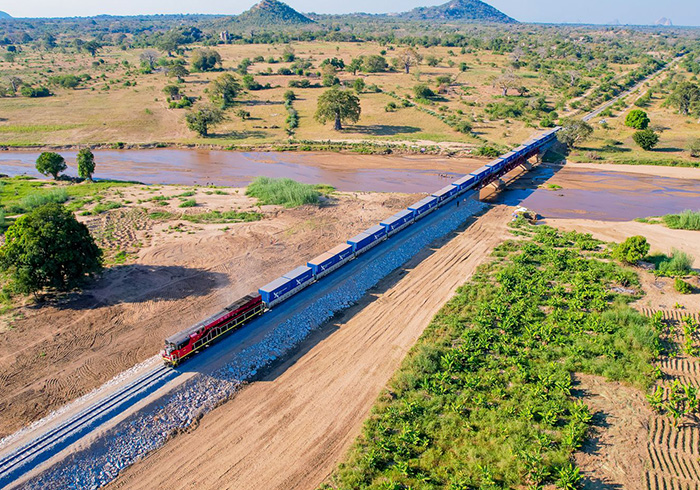
The package, signed in December last year, will fund the rehabilitation of the 1,300km brownfield railway linking the Port of Lobito on Angola’s Atlantic coast with Luau on the border of the Democratic Republic of the Congo, together with the adjoining mineral terminal at the port.
While rehabilitation works have already begun, the financing “enables the full upgrade programme to be completed”, Fola Fagbule, AFC’s director and head of financial advisory, told GTR.
LAR, a joint venture between Trafigura and Mota-Engil, has operated the corridor under a 30-year concession since 2024.
The company transported more than 200,000 tonnes of cargo in 2025, Fagbule said, adding that volumes are expected to increase as the upgrades progress.
In announcing the financial close, AFC revealed it acted as co-financial adviser alongside Eaglestone, “leading on the structuring and mobilisation of financing” for LAR.
Fagbule added the institution’s mandate covered “the full arc of the financing”, including “developing the financing strategy and structure, preparing the project for lender due diligence, engaging and coordinating with DFC and DBSA, supporting negotiation of the financing documentation, and managing the process through to signing in December 2025 and financial close in June 2026”.
Its role also encompassed negotiations around the railway and mineral port concession agreements and “the structuring of the security package”, Fagbule said, “reflecting the complexity of financing an operating brownfield concession connecting multiple jurisdictions”.
AFC declined to comment further on the transaction’s credit structure.
The financing will support rehabilitation of the railway line and ancillary infrastructure, including bridges, stations and crossing-loop extensions, as well as upgrades to signalling and telecommunications systems, a modern operational control centre, maintenance workshops at Lobito, Huambo, Cubal and Luau, freight transit terminals at Lobito and Luau, and the restoration of the mineral terminal.
Announcing the financing in December, Trafigura described the railway as “the shortest and most direct import-export route” linking the DRC’s Copperbelt mining region with international markets via the Atlantic Ocean.
The wider Lobito Corridor is expected to be one of several major transport projects reshaping global trade routes over the coming years.
Advisory firm Pangea-Risk recently identified the corridor as part of a “new wave” of strategic infrastructure expected to expand export capacity and redefine trade flows, with phased works continuing through 2026 and 2027.
“As one of the continent’s most strategic transport corridors, the project will strengthen regional connectivity, facilitate trade, and unlock new opportunities for economic growth across Angola and the wider region,” said AFC president and chief executive Samaila Zubairu in a statement.
AFC’s advisory team was led by Fagbule, while Eaglestone’s team was led by founding partner Nuno Gil.
Legal advisers to the lenders were Clifford Chance, with Morais Leitão and ALC Advogados acting as Portuguese and Angolan counsel. LAR was advised by Latham & Watkins, with Vieira de Almeida and Prime Advogados advising on Portuguese and Angolan law.