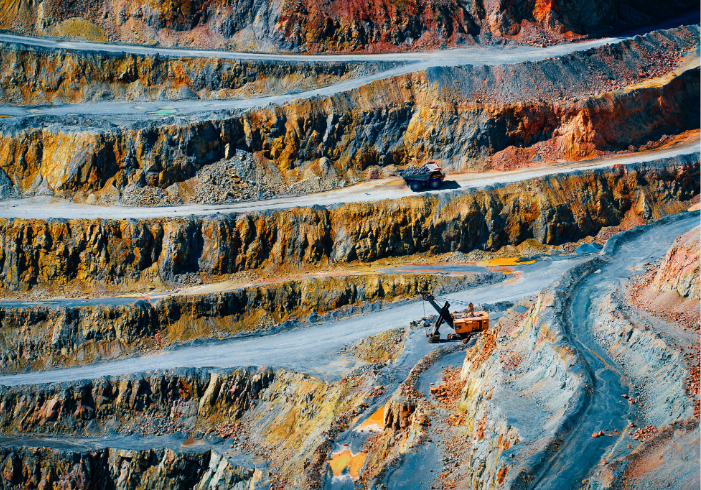



The EU is continuing to struggle with securing financing for the production of critical raw materials and risks running out of vital minerals for renewables, according to new research.
A report from the European Court of Auditors (ECA) showed financing the extraction, mining and processing of critical raw materials in the bloc is still “just beginning” and bottlenecks are hampering progress.
Lenders currently consider mining and processing projects – particularly the exploration phase – to be “high risk” due to price volatility, energy prices, long timelines and ESG concerns.
As a result, exploration, mining and processing activities in the EU face “significant difficulties in securing financing”, the ECA said.
“Projects need money. They don’t need just moral support or warm words,” Keit Pentus-Rosimannus, the ECA member responsible for the audit, told a press briefing on Monday, February 2.
Financing processing projects also requires a stable supply of materials, the report said, which risks a “vicious circle” where lack of supply prevents processing projects from developing, which “reduces the impetus to secure supply”.
Consultancy giant McKinsey said in October last year that nearly US$5tn in capital expenditure could be needed to address a looming shortfall in metals supply.
The ECA recommended that the European Commission should carry out a consultation by 2027 to develop ways of facilitating investments in exploration, extraction and processing.
The bloc has also made limited progress on its own targets to diversify its imports of minerals such as lithium, cobalt and copper from a small number of countries, including China and Chile.
The goals were set as part of the Critical Raw Materials Act (CRMA), which was adopted in March 2024 to secure a supply of 34 vital materials and ensure the EU has sufficient supplies to make products like batteries, wind turbines and solar panels.
The non-binding targets cover 17 ‘strategic’ raw materials. The EU is currently aiming to extract 10% of these materials, process 40% and recycle 25% domestically by 2030.
But as yet, Europe’s mining capabilities are underdeveloped, Pentus-Rosimannus said.
“Almost all the processing of critical raw materials is done outside the EU and for the few materials that are processed in Europe, the number of facilities is going down, not up,” she said.
“It is still difficult to secure funding for any activities related to producing critical raw materials, although things are improving. Even if projects go ahead, they can take a very long time, partly due to complex permitting procedures.”
Just seven out of 26 materials that are critical for renewables have recycling rates between 1% and 5%, and 10 are not recycled at all – meaning they all have to be imported.
“This makes us vulnerable and discredits our goal to be a strong, independent geopolitical power, especially if any of our trading partners decides to weaponise the dependency we have,” said Pentus-Rosimannus.
“It is therefore vital for the EU to up its game and reduce its vulnerability in this area.”
The ECA also found that the reasoning behind the targets was unclear, with the EU’s domestic mining capacity sitting just two percentage points below the 10% target when it was originally set.
“However, for many individual materials such as natural graphite or rare earth elements, the EU was far from reaching the target level,” the report added.
Other recommendations by the auditing institution included improving the granularity of trade data, making sure that future raw material targets are justified, and tracking EU funding for projects related to critical raw materials.
The ECA also suggested expanding the act’s eligibility for strategic projects to include more critical raw materials. Under the CRMA, strategic projects – which typically benefit from faster processing times and facilitated access to funding – do not receive direct EU funding.
The projects are spread across 13 member states and are aimed at boosting domestic raw material capacities. “Many selected projects will struggle to secure supply for the EU by 2030, in particular the ones in early stages of development or lacking offtake agreements with EU-based customers,” it said.
The report flagged, too, the lack of direct impact produced by strategic partnerships, including the EU-Mercosur agreement with Argentina, Brazil, Paraguay and Uruguay, which has not yet been ratified by each EU country.
However, some progress has been made over the past five years, Pentus-Rosimannus noted.
“I think the understanding of the urgency is definitely there,” she said. “If you compare where we stand now to five or 10 years ago, then the several initiatives that have been introduced have given an extra push to all the developments.”