

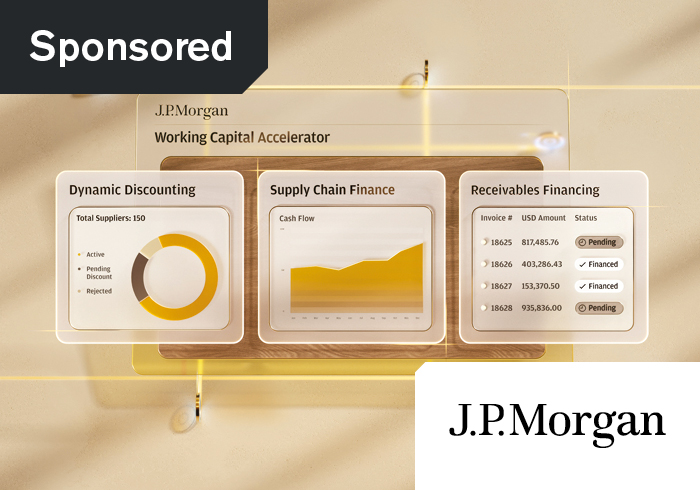
Supply chain disruptions, shifting liquidity needs and digital transformation obstacles are forcing working capital to the top of the corporate agenda. J.P. Morgan Payments is responding by bringing more of its trade and working capital capabilities into a more unified model. Its new Working Capital Accelerator platform is the clearest sign of that shift.
Working capital management is no longer just about freeing up cash at the margins. For many corporates, it is becoming a more strategic exercise to protect supply chains, preserve liquidity and give treasury and finance teams more room to manoeuvre when conditions turn. In today’s volatile market, the question is not simply how to fund working capital, but how to manage it more intelligently.
That shift helps explain why J.P. Morgan Payments is bringing more of its trade and working capital offerings together under a single digital umbrella. The bank’s Working Capital Accelerator platform may be the most visible sign of that, but the wider effort is to bring its wealth of expertise in product, technology and client delivery into close alignment.
Corporates are no longer looking for a bank merely to put a programme in place and keep it running. They want help navigating a more demanding environment, with financing, structuring expertise, data and practical guidance working in tandem.
“Back in the day, you would nominate a working capital provider to provide the technology platform and facilitate a supply chain finance programme, and that was really all it did,” says Dominic Giordani, global co-head of supply chain finance product management at J.P. Morgan Payments. “Today, clients are looking for prescriptive supply chain advisory support and for help managing all those different complexities at the same time.”
Rather than simply being treated as a funding tool, working capital is becoming a broader strategic discipline. It is shaping how companies think about liquidity, procurement, supplier resilience and day-to-day execution. Seen through that lens, fragmented product delivery shifts from a legacy irritation to a genuine constraint on execution.
A more joined-up model
One reason this matters is that fragmentation has long been one of the quieter frustrations in trade and working capital. Products offered by banks have often developed in parallel, leaving clients to navigate between different systems, interfaces and workflows. For finance teams, the result is familiar: multiple log-ins, inconsistent processes, and the sense that each solution operates in its own silo.
J.P. Morgan Payments’ answer is to bring more of those capabilities together. The Working Capital Accelerator platform currently supports supply chain finance, receivables finance and dynamic discounting, with trade loan capabilities intended to follow. Over time, the aim is for it to become the primary access point across the bank’s wider trade product set.
“The Working Capital Accelerator platform brings those products into one place and gives clients a more unified way to access them,” explains Giordani. “They can then use different solutions as their needs and priorities evolve.”
The Working Capital Accelerator platform currently supports supply chain finance, receivables finance and dynamic discounting, with trade loan capabilities intended to follow.
Crucially, it makes the experience more coherent for users. Finance teams gain a simpler way to move between solutions as priorities shift, while suppliers are spared some of the portal clutter and process friction that have long dogged these programmes.
“This marks a shift away from fragmented systems and static reporting towards real-time, enterprise-wide insight,” notes Heather Crowley, global head of trade & working capital product at J.P. Morgan Payments. “Through the Working Capital Accelerator platform, we are helping clients manage working capital more strategically and use it as a source of competitive advantage.”
Cutting the friction
For all the talk of strategic working capital, implementation is still where many programmes lose momentum. The business case may be compelling, but it can quickly weaken once execution timelines begin to slip, held back by complex bespoke data integrations and an already under-resourced IT function.
“Technology should not be the barrier to implementing a supply chain finance programme,” asserts Giordani.
J.P. Morgan Payments’ response is deeper integration, particularly through enterprise resource planning (ERP) add-ons and connectors that sit within systems such as SAP and Oracle. Instead of asking clients to contort their data around bank-specific file structures, the aim is to let them keep working in their existing systems while the bank handles the translation on its side.
That is a marked departure from more traditional models, where corporates had to build extraction logic, shape files to fit bank requirements and then wait for the institution to process them. This effectively baked friction into the process. In a world of APIs and cloud computing, that is no longer a sustainable way to run a modern implementation.
A long implementation programme can easily miss the moment it was meant to address. Conditions change and internal priorities shift. “Today, extending payment terms might be a client’s objective, but if you’re stuck in a six-month technology implementation cycle, things can change and other competing priorities may further delay the launch of a supply chain finance programme,” says Giordani.
That helps explain why the ERP integration angle of the bank’s new platform is resonating with corporates. It gives finance teams a stronger internal case when dealing with procurement and IT, especially when the proposition is not a lengthy bespoke build, but a solution that can be enabled within an existing environment.
The bank has embedded connectivity solutions with the likes of Oracle Fusion that are designed to lower one of the biggest barriers to entry for corporates looking to launch a supply chain finance programme. So, rather than spending months on implementation, clients can simply switch it on.
Consistency at scale
Reducing friction at the implementation level is only part of the challenge. The harder test is whether that same model can hold together across markets where tax rules, regulation and day-to-day practice can differ sharply. In trade and working capital, that is often where the promise of consistency starts to fray.
J.P. Morgan Payments’ Working Capital Accelerator platform is designed to tackle that problem directly, absorbing local variation without splintering the client experience. Currently, the platform supports over 60 different jurisdictions and 27 currencies, while maintaining a single front-end user experience across all markets.
That does not mean every market works identically behind the scenes. In Mexico, for example, specific data points may be needed to support tax receipt issuance. In parts of Asia, local indicators may be required for regulatory purposes. The platform is designed to accommodate those differences within a common framework. “The rails are the same,” says Giordani. “The data points we pull from client systems may differ to support local needs, but it all comes into the same platform and is managed there.”
Once a programme moves beyond its first phase, that level of consistency is just as vital. Companies often want to add regions, business units or supplier groups over time. In fragmented environments, each step can mean new data setups and configurations along with an additional round of implementation work. In a unified architecture, expansion is less about rebuilding and more about extending what is already in place.
Supplier experience matters too, for a simple reason. Working capital programmes may be structured from the buyer’s side, but they only gain real traction and scale if suppliers find them easy to use. J.P. Morgan Payments’ platform introduces a single sign-on model and a refreshed interface designed to simplify access, alongside a supplier information management capability that allows programme changes to be handled digitally rather than through a service centre.
The next frontier
The Working Capital Accelerator platform points to a broader shift in how J.P. Morgan Payments is organising its trade & working capital business around client pain points by reducing the friction of doing business. Rather than treating technology, product and delivery as separate tracks, the bank is trying to bring them together in a more holistic and digital model.
With the platform now established, attention naturally turns to what it might enable next. “This is a very exciting time, particularly when you look at how AI can be overlayed into our platforms and made available to our clients for consumption,” says Giordani. “That is the next frontier in digital working capital management.”