
The digital trade ecosystem is brimming with vendors, technologies and standards. At a small facility in England, a collaboration between academia and industry is trying to figure out how to align them all into transaction structures that can be used by businesses big and small, the world over. GTR went to take a look.
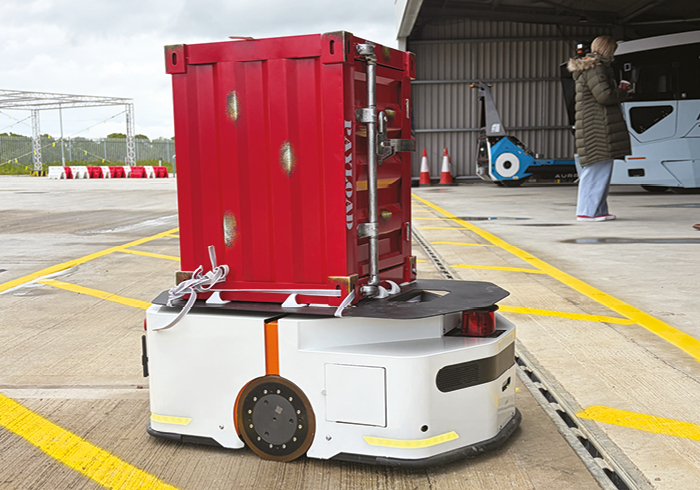
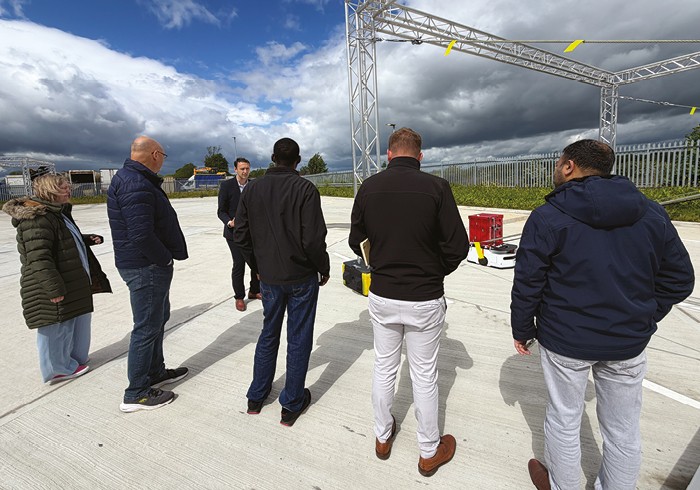
In a corner of the north-east of England, a machine that closely resembles a robotic vacuum cleaner is carrying a miniaturised cargo container across a windy cement yard.
Its lights flash from white to green and back to white for several minutes before its remote-control operator manages to get it underway.
The machine is simulating an 8,200km flight from Chengdu Shuangliu International Airport to our current location, Teesside International Airport, but in reality its trajectory is a juddering 20 metres or so between two newly built gantries.
We – staff from the Teesside Digital Testbed, a smattering of local government and business representatives, and a GTR reporter – watch on as it makes the mock journey from landside to airside at Chengdu. It takes “flight” across the cement before “landing” at Teesside, where it passes through sensors that theoretically detect what is inside the container and compare it with digital shipping documents.
The demonstration in late May is part of the Testbed’s reason for being: trying out the hype, promise and ideas of digital trade and trade finance. Do concepts thought up by tech companies survive contact with the complicated reality of moving goods across borders?
To do so, the Testbed aims to be a hub where businesses, governments, logistics companies and banks can experiment with how to turn electronic documents, rival and complementary platforms, data-sharing systems and even autonomous cargo-handling vehicles into a seamless whole. That knowledge is then shared with trading businesses.
The initiative was created by Teesside University, which is based in the nearby city of Middlesbrough. The school has a contract to operate the Testbed from the local government and owner of the site, the Tees Valley Combined Authority. The authority also owns the airport itself, as well as the Teesside Freeport, which was launched in 2021 and describes itself as the country’s largest.
The facility, wedged between a busy rail line and the airport grounds, opened in September 2025 at a cost of £3.5mn footed by the UK government’s freeport seed capital fund, although little activity occurred over the winter.
The location is an apt setting for real-world testing: the demonstration is held against the background hum of jet engines (although those belong to aircraft testing sustainable aviation fuels and flying Royal Air Force manoeuvres), and is at one point interrupted by a long goods train trundling past.
The man running the Testbed is Teesside University associate dean David Hughes, alongside technical lead professor Olugbenga Akinade and policy lead Dr Martina Ferracane. Speaking after the demonstrations in the portacabins that make up the Testbed’s offices, Hughes says the planned benefits of the Testbed are twofold.
The first is the reason it has attracted interest or partnerships from multilateral lenders and the likes of the International Chamber of Commerce’s Digital Standards Initiative (DSI) and the International Centre for Digital Trade and Innovation: it is a proving ground for digital trade concepts that are applicable worldwide.
Digitalising international trade – the customs paperwork, shipping documents and financing elements – has for decades been a slow and grinding effort. There is no shortage of technological solutions on the market, but all the parties that make up international trade have often struggled to figure out how they can fit together to add up to one digital chain.
They also have to be simple and of obvious benefit for trading businesses that are usually already time-poor and focused on keeping up with day-to-day demands.
During a 1.5-hour presentation to the gaggle of visitors, Hughes ticked off the vast number of steps required to execute a regular trade transaction – including the many, many forms and the frequent need to re-enter or duplicate information. He also described the acutely expensive traps that lay in wait for anyone who inadvertently makes an apparently meagre mistake.
But it is an alternative vision that the Testbed is trying to make a reality: a world where data is entered at the beginning of a transaction and seamlessly flows through to the end, trusted by all.
As with many topics associated with digitising trade, the nagging question is whether these ideas and experiments can be translated into real-world time and cost savings for businesses. A small firm may only have one or two people tasked with handling the whole gamut of import and export paperwork: compliance, shipping and financing.
That is the case for Azotic. At a site near Middlesbrough, one of the main cities in the Tees Valley, the company makes a nitrogen-fixing bacteria used by farmers as a way of reducing fertiliser consumption. Dan Wallis, Azotic’s operations director, says the firm has just one person in charge of managing all its global shipments.
“We’re a small business with cash flow issues; delays and disturbance in the supply chain of shipping then affect us from a financial perspective,” Wallis tells GTR after the demonstration ends. “If it was all digitalised, it would make it a little bit easier.”
Azotic recently shipped samples to a prospective buyer in Chile, which were all destroyed when they arrived at the airport because of a discrepancy on the certificate of origin, Wallis said. Such a fumble can delay a sale by a whole year if the samples do not arrive at the right time of the year for use on crops.
Those involved in the Testbed want digital trade solutions to be accessible to small businesses like Azotic, not just large corporates. Hughes says the end result of trade digitalisation must be a system that is accessible to small and micro businesses around the world. Many of those use relatively unsophisticated methods to carry out transactions, such as an unwieldy combination of WhatsApp and paper invoicing.
“We know that we have to have mobile-first solutions, and that any solutions we build and roll out here need to be accessible, or at least we need to be able to work with small businesses anywhere in the world,” says Hughes, rather than build “massive shiny systems that shut out the smallest businesses”.
“The one thing we can’t let digitalisation and AI do is just create barriers that are even greater.”
On a local level, the Tees Valley authority’s support for the scheme is because they believe exporters in their part of the country stand to gain a competitive edge if they are first movers on digital trade.
“The Tees Valley was one of the [areas] most affected by Brexit and has some of the lowest exports in Europe and certainly in the UK,” Hughes says of the region, roughly halfway between York and Newcastle. The expectation, he says, is that making trade more efficient will “grow that competitiveness, giving businesses the tools they need to grow and expand”.
While small firms, such as Azotic, can access the Testbed for free through a government support programme, larger firms, such as banks, have to do so on a commercial basis.
International impact
So far there has been greater interest in the Testbed’s activity from overseas than from local businesses. Hughes says he has fielded requests from foreign governments that want to use the facility to test-drive digital trade portals, known as single window systems.
There have also been visits from multilateral development banks (MDBs) that want to encourage member countries to adopt digital trade regulations and processes.
“What we’re realising is that as we drive through legal reform, we need to put tools in people’s hands to actually be able to realise the benefits,” says Hughes. “The MDBs have got the responsibility of making sure that it doesn’t just cascade to the very biggest players, but that it cascades down the supply chain to the very smallest players.”
The Testbed is working closely with the ICC’s DSI, which has long been at the forefront of trying to develop a globally harmonious digital trade system. The work has included trialling the DSI’s Key Trade Documents and Data Elements project, a lengthy desktop exercise to standardise data points for the full gamut of international trade documents.
Among the multilateral lenders using the Testbed are the European Bank for Reconstruction and Development (EBRD) and the Asian Development Bank (ADB), both of which have trade and supply chain finance programmes that typically serve emerging market banks. Hughes says the EBRD is using the facility to help develop an undisclosed digital trade project set to launch in 2027.
Oswald Kuyler, a senior digital trade advisor for the ADB, describes the Testbed as “genuinely unique” globally. “The partnership provides direct access to the systems, processes and stakeholders involved in trade, allowing us to move beyond theory and focus on what actually works in practice, with an institution that’s primarily motivated by resolving the core issues hindering scale,” he tells GTR.
“This is a critical step towards a future where over a hundred million SMEs around the world can create trusted digital records using the software they already use, and exchange them through mechanisms that fit naturally within their existing business processes.”
Not far from the airport sits the port of Teesport, which houses terminals for steel and potash export, as well as container terminals. Plans are underway for the port to explore the use of autonomous vehicles there, as well.
In June, the Testbed is set to broaden its activities beyond its current site and carry out live trials at the airport, using the same autonomous vehicles.
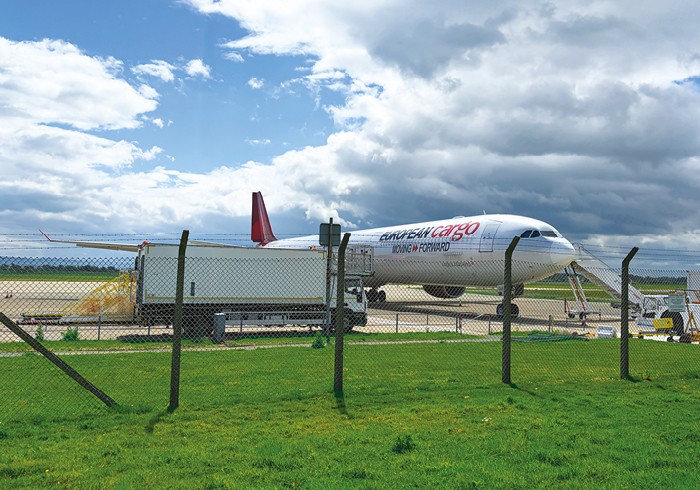
Until recently, real flights were arriving from Chengdu, operated by freight airline European Cargo. The airline entered administration shortly before press time, meaning that particular journey will remain simulated, for now.