

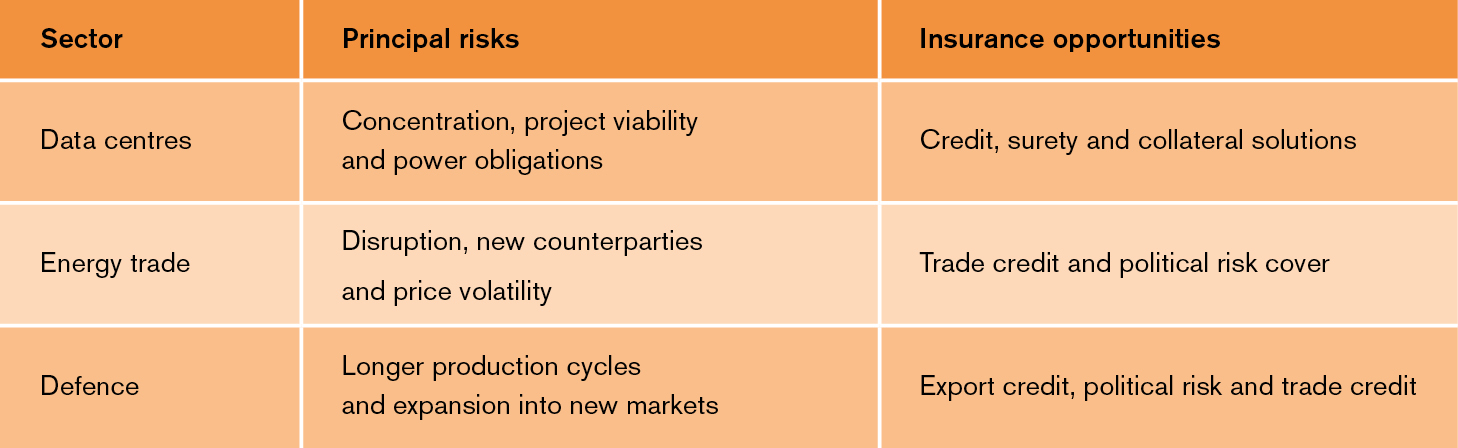
The build-out of data centres, disruption to energy trade flows in the Middle East and western governments’ surge in defence spending are three of the most significant macroeconomic trends hitting global markets in 2026. All three create trade-related risks – but also opportunities. GTR examines how the insurance market is responding.
The data centre boom
The rapid rise of artificial intelligence is driving one of the largest capital investment programmes the private sector has ever seen: a global effort to build data centres capable of storing vast amounts of information and processing the intensive workloads needed to train and operate AI models.
The companies behind the build-out include tech giants Alphabet, Amazon, Meta, Microsoft and Oracle – known as hyperscalers – as well as specialist providers dubbed neo-clouds, such as CoreWeave, Core Scientific, Crusoe, Lambda, Nebius and Nscale.
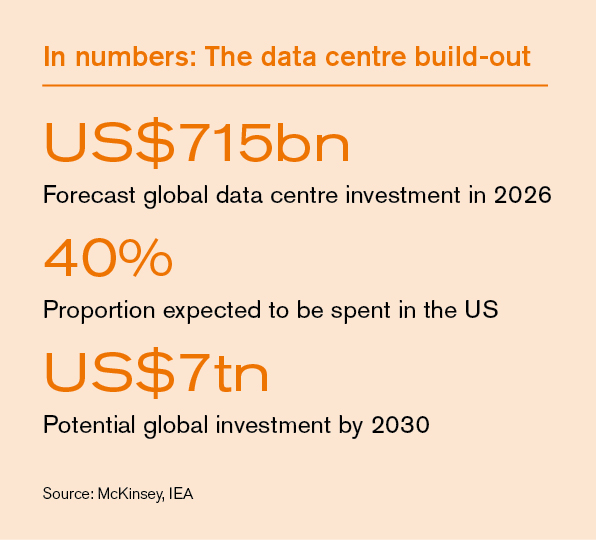
The capital expenditure of just five technology companies topped US$400bn last year, according to research from the International Energy Agency (IEA). Across the wider market, and based on spending plans announced so far, data centre investment is expected to reach US$715bn in 2026, the agency says.
To put this year’s forecast into context, the IEA notes this is “substantially more than annual investment in the entire energy sector of the United States”, which totalled nearly US$600bn in 2024.
At least 40% of spending will be in the US, a 2025 McKinsey report predicts. Globally, the total could reach as much as US$7tn by the end of the decade, it says.
The financing behind the build-out takes many forms, including corporate lending and project-level debt, and can involve commercial banks, private equity, private credit, infrastructure funds or governments.
“Not enough attention is being paid to the potential stacking and clashing of risk.”
Todd Lynady, WTW
The scale of the investment brings risks, and insurance brokers and underwriters are reporting a surge in demand for cover. Insurance is needed across the data centre lifecycle, from the initial construction stage through to procuring crucial inputs such as chips and, once operational, securing power supply.
Cascading risk
On the face of it, the size of this demand would seem to pose an immediate capacity risk.
With project values running well into the billions of dollars, the sheer volume of cover required could mean underwriters quickly reach their limits. Zurich warns in a 2026 report that many lenders are seeking insurance for the full value of a project, creating a “significant stress point” for the market.
Some insurers interviewed by GTR, however, are not immediately worried. Both Coface and Allianz said they had no concerns over capacity at present. But the sheer size and complexity of data centre development will require a considered approach to managing its risks.
Todd Lynady, regional head of credit risk solutions for North America at broking giant WTW, says the market has already developed new strategies for addressing these challenges.
WTW, which has a “global strategic focus” on data centres, has brought together several business units to create a global digital infrastructure group aimed at helping clients manage the full spectrum of risks tied to data centres and related assets. This includes most traditional insurance coverages as well as performance, credit and non-payment risks, Lynady says.
Underwriters may seek to mitigate obvious concentration risks by spreading coverage across different borrowers and projects, providing “a few hundred million here, a few hundred million there”, he says.
“But not enough attention is being paid to the potential stacking and clashing of risk.
“Across these projects, many of the same counterparties appear repeatedly. On the surface, you’re seeing the same names a lot, and it could end up looking like a concentration on a single name or project. They may be viewed as somewhat separate, but one domino could cause other dominoes to start to fall. That’s capacity issue number one,” Lynady says.
The limited financial track record of many projects creates a further challenge, says Sam Ashdown, Coface’s UK head of underwriting.
“Obviously, a lot of these data centres are not up and running yet. They’re not revenue-generating,” he says. “How we underwrite is largely the same as for any risk – based on the financial information available and any other influencing factors – but here there might not be an awful lot of information to go on.”
Power struggles
The biggest potential “snag” for the insurance market is access to, and pricing of, power, says Daniel Machado, growth leader for Aon’s North American surety and subcontractor default insurance team.
Data centres are enormously energy intensive, and the IEA estimates that electricity consumption for supporting artificial intelligence will treble by 2030.
Some hyperscalers are integrating power generation into projects, but connecting to the local electricity grid is a complex and potentially costly exercise, Machado explains. In the US, an operator will need to set out how much power it expects to draw and cover the cost of necessary infrastructure upgrades.
“The independent system operators, or grid caretakers, require security that it’s a viable project and the developer is going to pay,” he says.
Then, once operational, electricity usage is governed by a power purchase agreement, which will likely require the operator to pay a minimum amount if a project does not end up using as much energy as expected.
“That also needs to be secured,” Machado says. “And what we are seeing is that utilities have made security requirements incredibly high, which could tie up large amounts of capital for years.”
In practice, companies are resistant to posting millions or billions of dollars in long-term cash collateral. Some well-rated firms have turned to the bank market, using standby letters of credit in lieu of cash.
For Machado, this requirement could also prove to be an opportunity for insurers willing to offer a surety bond, essentially guaranteeing that if a claim is made, the utility company will be paid in full by the underwriter. The insurer would then seek to recover the amount paid from the principal.
“What we are seeing is that utilities have made security requirements incredibly high, which could tie up large amounts of capital for years.”
Daniel Machado, Aon
“It’s a difficult bond form. They’re hard to place, but they are essential for the data centre and energy build-out,” he says. “I’ve seen collateral requirements that are hundreds of millions of dollars every year, tied up for the operational life of the asset. If you can post that in a surety bond and just pay the premiums on that, it’s meaningful capital for clients.”
Mariano Viale, chief commercial officer of Aon’s global surety business, notes there is little uniformity in how bonds can be used. Some utilities or grid operators cannot accept them, and the product itself has traditionally been deployed to mitigate performance risk, for instance during construction.
“The surety market is deploying the solution in different ways, towards an on-demand, more liquid instrument,” he says. “The challenge there is the capabilities, the appetite and the expertise needed to underwrite in this environment, but from my perspective that’s precisely what makes it interesting.”
Even where a data centre operator opts to post collateral through a letter of credit without surety backing, this could help address capacity concerns for trade credit underwriters, says Ian Leslie, managing director at Marsh and head of the broker’s trade credit division for the UK.
“The energy issue is at a size level the market hasn’t really seen before, and there can be problems if the capacity requirement starts to outweigh the balance sheet of the company that needs it,” he says. “If there is collateral in place, that would be taken into account and could help with capacity constraints.”
Ultimately, Leslie says, the trade credit insurance market “needs to look at this as a sector that needs our help”, regardless of the complexity.
“This is what our product is here to do,” he says. “Yes, there is some nuance, requirements are not out-of-the-box; there may be multi-year tenors – but I don’t see any reason why the market can’t do it. This is a requirement that’s going to be needed time and time again, so the industry needs to look at how it can support data centres over the next five or 10 years.”
Energy trade disruption
In the initial weeks following the outbreak of conflict in the Middle East in February – when Iran responded to US and Israeli strikes by bringing traffic through the Strait of Hormuz to a standstill – there were widespread concerns about how the market would cope.
The threat of vessel attacks left cargoes of crude, fuel, fertiliser and other commodities stranded in the Persian Gulf, while strikes on production facilities prompted a wave of force majeure declarations across the energy sector.
One fear was that non-delivery of cargoes or counterparty defaults could trigger a spike in trade credit insurance claims, or spiral into court battles between counterparties.
Mercuria’s group CFO, Guillaume Vermersch, told the FT Global Commodities Summit in Lausanne in April that the trading giant was making provisions for such a scenario, saying: “We expect a lot of claims, with a lot of contractual disputes, a lot of force majeure interpretation, a lot of legal battles around that.”
Another concern was that price volatility could cause liquidity shortages among commodity traders, potentially pushing some into default. There is some precedent for this: in the first few months of the Covid-19 pandemic, numerous smaller traders – and a handful of larger ones – fell into insolvency as working capital dried up.
So far, however, history has not repeated itself during the Hormuz crisis.
“My personal experience is that clients have been very prudent and cautious as they have navigated this entire situation, and they’ve managed for the most part to trade their way out of the crisis without having to take the counterparties to court or arbitration,” says Sumeet Malhotra, a partner at WFW in Singapore and head of the law firm’s commodities and international trade practice.
“I saw companies going into a holding pattern, reserving their rights and setting out what their claims were, before deciding to cooperate with each other. To the extent that parties were stuck with counterparty default claims, those seem to have been paid.”
“My personal experience is that clients have been very prudent and cautious as they have navigated this entire situation, and they’ve managed for the most part to trade their way out of the crisis.”
Sumeet Malhotra, WFW
On the liquidity side, large traders and banks were quick to arrange emergency buffer facilities to absorb price volatility, while companies across the wider market “were making long-term decisions based on the quality of their relationships, and not short-sighted ones based on their P&L”, Malhotra says.
“Having said that, there could be somebody left holding the baby, and some of these claims will eventually go to court,” he says. “But we’re not going to see an absolute deluge. I’ve been genuinely impressed at how producers, traders, banks and insurers have developed the institutional memory from crises to navigate this one.”
New corridors
The crisis also reshaped trade flows in the energy market, particularly those centred on Asian imports. Before the conflict, more than 80% of cargoes passing through the Strait of Hormuz were destined for the continent, especially for buyers in China, India, Japan and South Korea.
By May, with the route still largely inaccessible, non-Middle East oil exports had reached record highs, the IEA found. Crude exports from the Atlantic Basin increased by 3.5 million barrels per day between February and May, the agency said in a report that month, with those flows primarily heading to “hard-hit east of Suez markets”.
For companies entering into new trade flows due to geopolitical uncertainty, insuring the resulting credit risk often becomes a higher priority, says Coface’s Ashdown.
“Trade credit insurance is relatively unique in helping businesses impacted by situations like the US-Iran war, when goods can’t flow,” he says. “Businesses have to look for alternative places or businesses to sell those goods, and if you’re looking to trade in a new market or with a new customer, insurance can fill that gap.”
Premiums: A buyer’s market
Ian Leslie, head of UK trade credit at Marsh, says premiums generally dropped significantly last year and have largely plateaued since, in the wake of strong competition in the market.
“If you’re going to lock in cover for two or three years, this is the market to be doing it in, to really take advantage of those commercial prices for as long as you can,” he says.
Sam Ashdown, Coface’s UK head of underwriting, also describes the market as “very soft”.
“There have been new entrants in the credit insurance space in the last couple of years, and it’s an increasingly saturated market, so that’s driving competition,” he says. “From a risk underwriting point of view, looking at the premiums available relative to the risk, I would suggest it’s a buyer’s market at the moment.”
Paul Carrington, head of Europe at Navitas Assurance Partners, an underwriting firm specialising in energy markets, gives the example of US energy producers entering into contracts with Asian counterparties they had never traded with before.
“These producers tend to be incredibly conservative,” he says. “If they haven’t got an investment-grade corporate guarantee from the buyer, they want a letter of credit or credit insurance, and we as the credit insurance market were able to step up where these new relationships were being formed.”
In some cases, even among established trading partners, Carrington says higher commodity prices have also driven demand for cover.
“Say a producer previously sold a cargo for US$40mn and the buyer wants to do a repeat trade, but that cargo is now 35% more costly. We’ve seen clients come to us and say they’re happy to take the risk on the US$40mn, but want some credit insurance cover for that additional 35%,” he says.
The growing role of underwriters in bringing greater security to these trades is not limited to covering non-payment risk.
Ashdown notes that underwriters are increasingly using their access to market intelligence to provide policyholders with real-time information, such as “early warning signs” that can signal a change in a company’s financial standing and add another layer of risk mitigation.
Alongside trade credit, the political risk insurance market is also “experiencing a period of elevated demand”, says Richard Wulff, outgoing executive director of the International Credit Insurance & Surety Association.
Although this is partly driven by “systemic geopolitical fragmentation, supply chain reshoring and structural macroeconomic realignment”, demand for political risk cover is not solely linked to transactional volumes.
Wulff highlights “structural institutional shifts”, including banks using cover as part of their capital relief strategies, as well as growth in longer-term project finance transactions.
Ongoing uncertainty
Despite confidence in how banks, traders and insurers have navigated the Middle East conflict so far, the energy sector still faces major uncertainty. As of press time, peace talks between the US and Iran have largely stalled and traffic through the Strait of Hormuz remains heavily subdued.
“It could be that we’ve not seen the full impact yet,” says Marsh’s Leslie. “We dealt with claims due to the Russia-Ukraine conflict, but they took a while to come to the forefront. This may be something we end up dealing with more as things go on. The longer this lasts, the more disruption businesses have and the more likely there are claims in the market as a result.”
Leslie adds that while businesses that already had cover have generally had little issue adjusting to new trade flows, requests for additional cover are being reviewed carefully.
“If you’re looking to increase your exposure in that area, that’s tricky,” he says.
Navitas’ Carrington suggests that geographical shifts in trade flows could place further strain on the market.
“European gas storage levels are at almost a multi-decade low, and entering into the winter refuelling season, we could see a surge of European buying as importers seek to meet the European Commission’s 90% winter storage target,” he says.
“Companies probably held fire on that in the hope the Strait reopens, and that means we could be entering a period where Europeans are competing with Asian buyers, which themselves have seen considerable supply disruption.”
At the same time, demand destruction in Asia has been far outpaced by the depletion of existing oil inventories and strategic reserves, which the IEA said averaged 13 million barrels per day between February and May.
Vitol’s chief executive, Russell Hardy, warned at the FT Lausanne event that the loss of supply will have a “longer-lasting effect” even if flows return to pre-conflict levels.
“We’re borrowing [from] product inventories to cover demand today, and they’ll need replacing,” he said.
For Carrington, this could mean the market “is entering a period of supply tightness and then price volatility”.
“It’s going to be interesting to watch what happens as the fundamentals begin to feed through,” he says. “And even if there is a peace deal, it only takes a slight road bump for Iran to turn off the tap again.”
Claims: High volume, low value
In the UK market, claims appear to be far higher today than before the Covid-19 pandemic. Ian Leslie, head of UK trade credit at Marsh, said at a July press briefing that the broker faced 556 claims in 2019, but around a thousand in each of 2024 and 2025. Based on the first six months of this year, he said Marsh is “expecting [claims] to be around that 1,000 mark again”.
However, there is an important nuance to these figures: the claims themselves are generally smaller in size.
“We are still seeing a higher number of lower value claims,” Leslie said. “The claims value side is certainly not an issue around limit acceptance in the market, writing cover. I can speak for our clients in that we are seeing good levels of coverage across all sectors.”
Steve Bramall, credit director for UK and Ireland at Allianz Trade says there has been “a continued trend in claims returning to historic normal levels”.
“This is a trend we have seen for a few periods,” he says. “We have seen a small increase, 2%, in our overall level of claims compared to the previous year and the average size of a claim has increased, but not materially.”
Western nations shore up defence
The western world is embarking on a decade-long acceleration of defence investment. Following a Nato summit last year in The Hague, all 32 members committed to upping public spending to 5% of GDP by 2035, spanning core requirements, infrastructure, industrial development and cyber resilience.
At this year’s summit in Ankara, Nato said its European members and Canada had already increased funding for core defence by more than US$139bn, a rise of 20% from the previous year. Members also announced more than US$50bn in new procurements, including air and missile defence systems, precision strike technologies and intelligence capabilities.
In practice, this surge in spending has implications for commercial activity and financing requirements. Defence manufacturers winning more government contracts may have to scale up production, source more components from suppliers, hold more inventory and potentially enter new export markets.
Export credit agencies often play a significant role in mitigating the risks of fulfilling those transactions. For example, UK Export Finance announced in June it would launch a £50bn Defence Export Fund, designed to support large-scale defence exporters by providing guarantees for bank loans to manufacturers or financing overseas buyers of UK products.
Other agencies long supportive of the defence sector, such as Bpifrance and Sace in Italy, have been joined by the likes of Germany’s Euler Hermes, which has traditionally backed relatively few defence deals.
The Berne Union says large defence transactions – as well as cruise ship and energy projects – drove medium-to-long-term export credit cover across the export credit agency sector to a record high of US$222bn last year.
Commercial opportunities
Outside the public sector, there has historically been mixed appetite for supporting the defence industry and little publicity around completed deals. That now appears to be changing.
Salomon Journo, head of credit risk solutions for WTW in France, says in a January paper there has been “a dramatic shift in how insurers approach the defence sector… over the past few years”.
“Before 2022, insurers were sometimes reluctant to get involved with defence deals due to the attitude that ‘war is bad’,” he says. “Now they are eager to be seen as supporting European defence. They also know that we’re in a period of strong government support for the defence sector.”
“In terms of driving demand, it’s also on us to get out to this sector and say ‘actually, we can help’.”
Ian Leslie, Marsh
The majority of requests for cover are likely to relate to longer-term transactions rather than traditional trade credit insurance, which would typically apply to contracts of less than 12 months, says Coface’s Ashdown.
“Long-tenor contracts – the build-out of aircraft, for example – would certainly be where you see the bigger uplift in people looking for cover,” he says.
Political risk cover is also a vital risk mitigant for defence companies in some markets.
Silja-Leena Stawikowski, senior account manager for special risk at WTW, says in the January paper that political risk insurance will typically cover losses arising from government actions or instability, such as confiscation, expropriation and nationalisation, as well as political violence, currency convertibility restrictions and transfer risks.
Such cover “essentially [gives] defence companies and their financiers a safety net when operating in or trading with high-risk countries”, she says.
“Even if a host government’s decisions or unrest derail a project, an insurance policy can compensate the company and stabilise its balance sheet.”
Untapped potential
While the defence sector is more closely associated with longer-term cover and the risks it addresses, there has also been an uptick in demand for shorter-term trade credit insurance, Coface’s Ashdown notes.
“It’s not a massively notable one,” he says. “But that’s logical when you have an increase in trade like this.”
WTW’s Journo points out that some defence sales are well-suited to short-term cover, such as munitions supply and management contracts. In France, defence companies often use trade credit insurance cover for the civilian parts of their businesses, he says.
While cover may historically have focused on higher-risk or slower-paying markets, Journo says that is changing too – particularly with public finances under strain in developed countries as well as emerging markets.
“Another thing we rarely saw in the past was companies buying cover on European buyers or EU-financed deals,” he says.
“But now that is happening for very large contracts. The margins are good enough to support buying the cover, and everyone understands that political and payment conditions can change rapidly.”
For Marsh’s Leslie, the defence industry expansion holds untapped potential for trade credit insurers.
“There are still a whole host of companies that don’t know what this product can do, and how it can help them,” he says. “In terms of driving demand, it’s also on us to get out to this sector and say ‘actually, we can help’.
“Yes, it may be a three-year procurement process – but we can still do that.”