
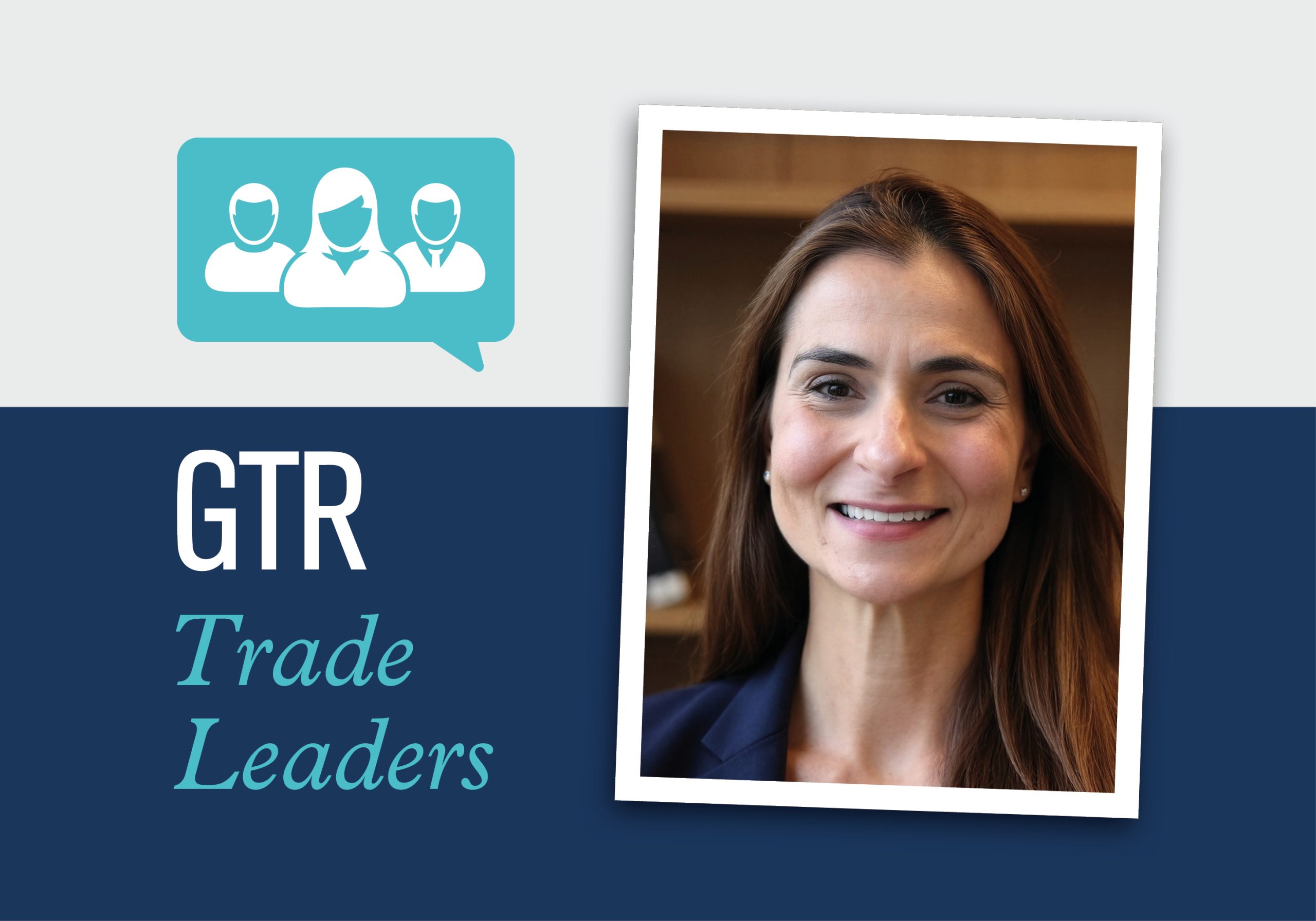
Sarah Murrow joined Allianz Trade – then Euler Hermes – in an entry-level customer service role in Baltimore in 2004, and has stayed with the company ever since, moving through positions in Paris and London before becoming the first female CEO of Allianz Trade UK & Ireland in 2021. In 2025, she made her return to the US to become CEO of Allianz Trade in the Americas, overseeing the US, Canada and Brazil.
For GTR’s latest Trade Leaders instalment, Murrow discusses what two decades of international moves have taught her about leadership, the untapped opportunity she sees for banks to drive credit insurance adoption in the US, and how founding the Women in Credit Insurance group was “one of the great accomplishments” of her career.
GTR: How did you end up at Allianz Trade and what has been your career trajectory since?
Murrow: I am American by citizenship but have spent a large portion of my life living in different countries. So when my husband and I moved to Baltimore in 2003, I was seeking employment with a company that had an international aspect. That’s how I found – at the time – Euler Hermes, now branded Allianz Trade.
I started in 2004 in an entry-level customer service role. It was a great way for me to learn the business, why our clients purchase our products, some of the pain points that they have. I worked my way up and eventually got my first big regional role as head of broker management.
In 2016, I was offered my first global role in Paris as the group head of commercial underwriting and product development. It was fascinating – I got to understand how credit insurance was used by customers around the world. A year later, I moved to London as commercial director for Northern Europe, which I held until 2021, when I became CEO for the UK and Ireland. In June 2025, I returned to the US to become the CEO of the Americas business, which is where I started! The goal was always to return.
I have literally spent half my life with the same company, which is really unusual. But the international mobility and the job and development opportunities that Allianz Trade has provided me – there’s been no reason for me to ever want to leave. I’ve always felt challenged, and the company has always rewarded hard work and a job well done with a new opportunity. I think there’s a lot to be said for that.
GTR: How did those regional moves shape the way you lead now?
Murrow: There are some basic fundamentals, especially around how to lead people, that travel well, no matter where you are: being clear about where we’re going as a business, giving people ownership, making decisions and creating an environment where people feel comfortable challenging me.
But there is a healthy degree of learning about different cultures. One book I oftentimes talk to people about is The Culture Map by Erin Meyer. She maps out cultures on eight different dimensions, including communication, hierarchy and decision-making – that’s been really helpful in guiding me along my journey.
GTR: You now oversee three quite different markets under one Americas remit. How different are the conversations you’re having with clients in each of those markets, particularly with USMCA renegotiation on the horizon?
Murrow: In recent months, the conversation’s been more heavily concentrated around uncertainty: tariffs, supply chains, input costs, interest rates and what all of this will ultimately mean for demand and credit risk. But the three markets are really different in how they operate.
For Canada, [tariffs] are not an abstract trade policy discussion, given how fundamental US trade is for many Canadian businesses. The questions around the future of trading relationships are very tangible, and this is much more of a discussion in Canada than in the US.
Brazil is different, again – significant growth opportunities, particularly around infrastructure and our surety line of business, but it’s also a market where disciplined risk assessment is critical.
There is a common thread throughout all three countries, though, which is clients are not asking us ‘will you insure this risk?’ but rather ‘what are you seeing?’ The focus on information and credit intelligence is actually becoming much more prominent in our discussions, more so than just the insurance.
“One of the biggest opportunities I see for the US market is the engagement of banks in credit insurance.”
GTR: At GTR’s US insurance roundtable last December, you said you’d like to see US banks drive SME credit insurance policies in the same way the UK market does. What’s stopping US banks from doing the same, at scale?
Murrow: This is one of the biggest opportunities I see for the US market – the engagement of banks in credit insurance.
I don’t think it’s simply about getting banks to buy more insurance themselves. A large part of the work is educating banks and lenders about the product and how they can enable greater financing opportunities and provide more robust solutions for the customers they serve. This is one of the key areas we’re working on within Allianz Trade.
With supply chain disruptions, more and more American businesses are interested in the credit intelligence side – not only the credit risk and information around their customer base, but also their suppliers. We see this notably with large US businesses that have complex supply chains.
GTR: How would you characterise the credit insurance market at present, particularly in terms of capacity and pricing? Do market conditions reflect the underlying risk environment?
Murrow: The market is continuing to be competitive. We’re seeing ample capacity from different insurers. It isn’t consistent with the underlying risk environment. I think there’s maybe been a bit of a lag effect – ample capacity and strong balance sheets have kind of carried us.
But corporate balance sheets will be challenged going forward. What we’re seeing is the cumulative effect of financing costs, tariffs and input cost pressures. These will eventually catch up.
Within Allianz Trade, we’re forecasting a 6% increase in global insolvencies in 2026, and the US forecast is a 9% increase in 2027. So there’s this divergence between where we currently see a soft, competitive market for credit insurance pricing, and where we’re heading.
GTR: You were the first woman to serve as CEO of Allianz Trade UK & Ireland, and you’ve since co-founded and chaired Women in Credit Insurance. What changes have you seen in female representation at senior levels in trade credit insurance over your career?
Murrow: It has been quite the privilege. What I would love to do is get to a place where that’s not notable – like being the first woman CEO is not a thing to communicate about, because it should be old news. But the work that I’ve done, indeed founding Women in Credit Insurance in the UK, which is a working group of ICISA, was one of the great accomplishments of my career.
The UK credit insurance market really embraced the initiative, and it’s taken off since then. A new Women in Credit Insurance group has actually started in Benelux, so it’s spreading, which is really exciting as well.
If I look back over my 22 years in the industry, I would say there are a lot more women executives now than there were back then. I think it’s only going to continue.
GTR: What draws you to the mentoring work you do, and what’s one piece of advice you find yourself repeating?
Murrow: When I look back at my career, I’ve had really good mentoring relationships, but I’ve probably had even more effective sponsorships. I think it’s important to differentiate the two. So I also talk to my mentees about sponsorship and making sure they build up credibility so that people are willing to advocate for you, and that requires a structured, intentional networking approach.
This is really what I focus much of my mentoring on: how to help individuals, especially women, who tend to struggle with this and with confidence around it, be more intentional about identifying and continuing to build credibility with sponsors.
I also recommend to my mentees taking on big projects or tricky topics and being the champion to solve them. That is really what gets noticed, so I oftentimes challenge my mentees: what is the mountain that you’re going to move? What is the one thing that you want to work on that will make an impact? People will see that you’ve delivered this.
GTR: What do you enjoy doing in your free time, and is there anything you wish you had more time to do?
Murrow: I have two daughters, and they are entering middle school and high school. So aside from trying to be a really good and engaged parent to both of them, I don’t find myself with tons of time!
I do love reading, and I love to cook – that’s one of the ways I de-stress after a long week, cooking for my family and for friends. And I love to travel – whenever I get a chance to travel for work, I always really look forward to it.