
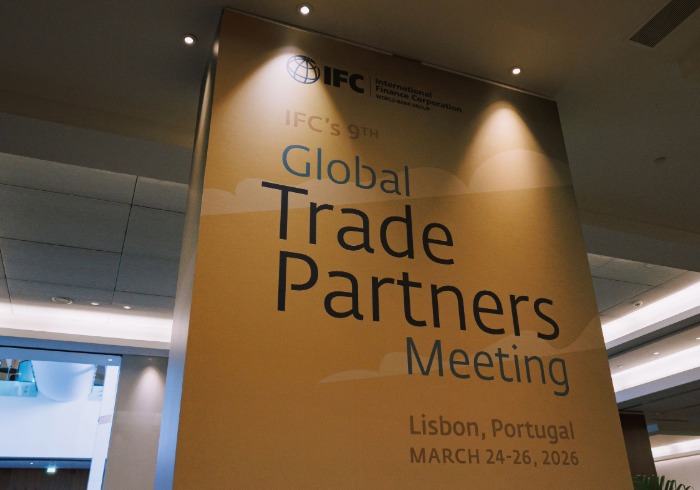
Portugal’s role in global trade finance is often framed by geography – a small nation that serves as a gateway between the Americas, Africa and Asia. But conversations on the sidelines of the International Finance Corporation’s flagship Global Trade Partners event, which took place in Lisbon at the end of April, suggest that it’s a market shaped less by scale than by its ability to operate across different trading systems.
The country is one of Europe’s most trade-dependent economies, with exports of goods and services equivalent to more than 40% of GDP, according to World Bank data. That openness has helped create a vibrant trade finance market that spans both highly commoditised intra-European trade flows and more complex risk-managed business across emerging markets, including Lusophone Africa, Latin America and Asia Pacific.
But like many other European peers, Portuguese banks are feeling every shift in global trade acutely, the heads of some of the country’s most active banks in the trade finance market told GTR on the sidelines of the IFC event – from supply chain rewiring and tariff uncertainty to persistent debates over capital treatment.
EU and non-EU split
The defining feature of the Portuguese trade finance market is the divergence between intra-EU and non-EU activity. Spain, France and Germany together account for around half of Portugal’s total exports, according to official government figures, and trade within the EU runs almost entirely on open account, says Jorge Loureiro, head of financial institutions group at Millennium bcp in Lisbon.
A shared currency, harmonised regulation and established relationships have largely removed the need for documentary instruments, he adds.
Beyond Europe, however, the picture shifts significantly.
It is across corridors with Brazil, Lusophone African countries – including major economies such as Angola and Mozambique – and parts of Asia that the full spectrum of trade finance products comes into play.
Loureiro notes Millennium bcp maintains active books across letter of credit confirmations, guarantee issuance, international factoring and supply chain finance tied to those routes, supported by a subsidiary in Mozambique, a shareholding in Angola and a branch in Macau serving as a gateway to Chinese banking relationships.
Meanwhile, Morocco, Algeria, Tunisia, Egypt and Turkey are all significant trading partners, he notes, as are Latin American and the broader Asia Pacific countries.
Portugal’s varied export market is led by machinery, appliances and vehicles, with major non-EU partners including the US, the UK, China and Canada, government statistics show. As a result, Millennium’s trade finance work spans a variety of sectors and geographies, Loureiro says, noting shipments of pulp and other raw materials to Turkey as an example of a “significant” line of business.
The bank’s goals are not to expand into new territories per se, he adds, but “the idea is to follow the client – we must have the best answers to accompany them”.
Underpinning the non-EU business is an extensive correspondent banking network alongside multilateral partnerships, including with the International Finance Corporation, the European Investment Fund (part of the EIB Group), and Portugal’s export credit agency – a mandate that recently shifted from Cosec to the BPF, the country’s development bank – that allow Portuguese banks to extend into markets where their own risk limits would otherwise limit capacity.
“Those multilaterals help everyone cover that part of the risk,” says Loureiro.
Supply chain rewiring brings opportunities and challenges
As with many European markets, Portugal’s trade finance industry is highly exposed to global supply chains – but its position across multiple trade corridors means those shifts are creating both opportunities and complexities.
“We’re in a climate of uncertainty – sanctions, tariffs, topics of regulation and the redefinition of supply chains,” says Loureiro, all of which “will have an impact, because companies obviously seek to optimise their sourcing”.
For Millennium bcp, strong relationships with global banks that help bridge the gap with its lesser-known markets, and “fundamental” support from its correspondent bank network, are key tools for navigating this environment “where the role of banks as generators of trust and as holders of risk mitigation instruments becomes even more important”, Loureiro says.
Millennium also recently adopted ISO 20022, the Swift messaging standard that carries data in cross-border payment messages, improving compliance screening capability and reducing cost for clients transacting in non-euro currencies. Loureiro describes this as a meaningful operational upgrade directly tied to the G20 commitment on faster cross-border payments.
Basel, ESG and employment concerns
One thing banks are clear about is that the Portuguese market does not have liquidity or risk appetite problems, with Novobanco’s head of trade and export finance, Paula Mota Pinto, arguing there is sufficient funding and a healthy demand for trade finance.
“Commercial banking institutions are actively engaged in supporting the sector, delivering sufficient liquidity and exhibiting robust risk tolerance within trade finance and supply chain transactions,” Mota Pinto, says.
However, the capital treatment of trade finance remains the market’s most persistent structural frustration. “Conservative capital requirements directly affect capital consumption and pricing capacity, thereby impacting support for SMEs and, consequently, exports,” she notes.
“This dynamic creates additional pressure on company margins, often leaving stakeholders with limited options other than conducting transactions without sufficient risk mitigation or access to appropriate financing.”
Looking forward, ESG also remains a challenge, Mota Pinto flags. Significant Portuguese export sectors, including renewable energy, where demand for trade finance has grown fastest in recent years as solar and wind project developers ramp up international procurement, are integrating sustainability standards into their operations.
But she notes the cost of ESG compliance, increasingly a prerequisite in the world of trade, “represents an additional concern as it may place further pressure on company profit margins”.
At the same time, concerns over attracting a new generation of trade finance experts afflict the country’s industry as much as elsewhere around the world. At Novobanco, “there is a growing emphasis on nurturing talent and ensuring the next generation is equipped with the skills and expertise required to sustain innovation and meet future challenges”, says Mota Pinto – a matter of urgency for a country that is so heavily reliant on trade.