
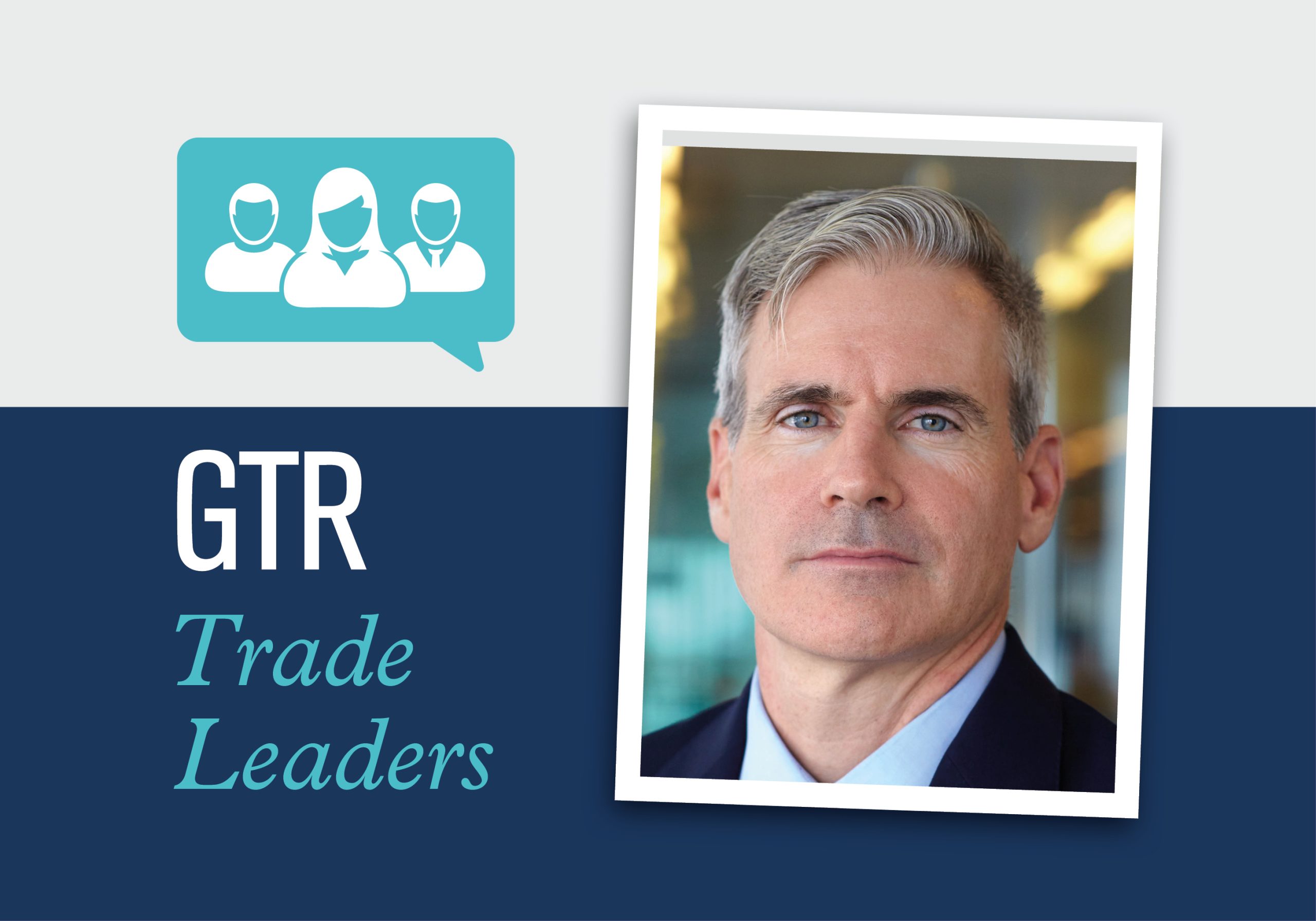
Supply chain finance has moved from a specialist treasury tool to a much more central part of how corporates think about resilience, liquidity and operational risk. For Geoff Brady, outgoing head of global trade and supply chain finance at Bank of America, that shift has been one of the defining changes for the industry over the past decade.
Brady says the product continues to grow strongly in the US, even as interest rates, supplier behaviour and geopolitical disruption reshape how programmes are used. Bank of America has seen supply chain finance volumes expand by more than 50% over the past four to five years, he says, with most of that growth coming from new programmes rather than existing mandates simply ramping up.
In this latest instalment of GTR’s Trade Leaders series, Brady – who is moving into a new role within Bank of America’s global capital solutions group as the bank expands its capabilities in structured working capital and supply chain-related financing – reflects on shifting client needs, digitisation, innovation and leadership.
GTR: Where are you seeing the most meaningful shifts in client behaviour right now?
Brady: There is a lot of talk about tariffs, but honestly we haven’t seen tariffs be as impactful globally as people might think. Interestingly, at the bank, we’ve had a lot of clients ask us about tariff refund discounting, which one could argue is the antithesis of tariffs negatively impacting trade.
Where we have seen a little bit more activity is around liquidity behaviour and strategy, particularly in the Middle East and to some extent Eastern Europe. You’ll see banks or corporates looking at how geopolitics might impact their next 18 to 24 months and taking steps to shore up what liquidity they might be able to access today.
So we’ve seen – and I expect we’ll continue to see – some drawdowns on trade loan facilities, or pricing widen a little bit where it had been very thin before, just because liquidity has become more consequential.
What’s really interesting, though, is this transformational moment around data infrastructure. People are now distinguishing between core infrastructure and data infrastructure, being the huge data centre build-outs happening in the US and globally. And while AI feels digital, the infrastructure behind it is incredibly physical. These are massive construction projects that lend themselves naturally to the things trade finance has always done well – optimising supply chains, working capital and efficiency.
A lot of the participants – hyperscalers, data centre operators and digital infrastructure providers – toggle between being high technology companies and general contractors. At times, they’re acting like startups that suddenly find themselves in the construction business. Now that we’re a few years into these large-scale data centre build-outs, some are being more deliberate about how to achieve their goals, not just whatever gets the fastest result. And we’re seeing clients take a more thoughtful approach to working capital and access to materials.
We’re also seeing more interest in inventory-type solutions, not necessarily because clients are trying to optimise working capital, but because they want certainty of access to critical minerals and critical components like microchips when they need it.
GTR: Reflecting back on your time as head of global trade and supply chain finance, what’s been the most surprising thing you’ve seen play out in the market?
Brady: The most surprising thing – not necessarily the most impactful, but definitely the most surprising – is the extent to which supply chain management has become such a prominent part of the global economic conversation. Nobody was talking about supply chains 10 years ago. It just wasn’t a thing people thought about.
I think Covid was really the first shock. People suddenly saw what supply chain disruption actually looked like. Whether it was exercise equipment, cleaning products or whatever else, people realised the whole system behind the entirety of global commerce, and how fragile it can be.
GTR: What about supply chain finance specifically? Do you still see it as a growth product in the US?
Brady: Absolutely. The numbers definitely bear that out. Over the last four or five years we’ve grown more than 50%, and about three-quarters of that growth has come from entirely new programmes, not just existing programmes ramping up.
What’s interesting is that the amount per invoice discounted has come down somewhat. Some of the very large suppliers are probably more rate-sensitive now, and if they can borrow a bit cheaper locally – whether it’s in the US, China or elsewhere – they’ll do that.
But despite that, we’re still seeing strong double-digit growth overall, which tells you the product has become more ubiquitous. More corporates are seeing competitors using supply chain finance to generate cash flow or build resilience from a working capital perspective, and they’re asking: ‘Why aren’t we doing this?’
And I think after 25 years in the US market, people generally know what supply chain finance is and what it isn’t. It’s been through financial crises, Covid and geopolitical shocks, and there aren’t many people left questioning whether it works as a working capital tool.
GTR: I was looking back through the bank’s GTR Leaders in Trade submissions over the last few years to get a sense of where you’ve been investing – things like procure-to-pay automation and supplier onboarding. What do you think has shifted the needle most for clients?
Brady: Post-Covid, there was a meaningful shift across the industry in terms of corporate willingness to go digital. Before that, the conversation came down to: ‘If this costs me a dollar more, I don’t want to do it.’
After Covid, there was more recognition that not being digital was also costing something. That really opened the door for fintechs, consortia and a lot of the digital trade initiatives we’ve seen over the last few years. Some of those ideas consolidated into solutions with real transaction flow, which I think was important.
From a Bank of America perspective, we thought about it in two ways. The first was to be more visible around some of these industry initiatives. My view when I came in was that people expect Bank of America to participate, and if our involvement helps bring others to the table, then that’s something we’re supposed to do.
The second part was then putting our money where our mouth was and doing something tangible with it. When we launched our open account automation product, the idea was never to create some proprietary Bank of America ecosystem that cornered the market. Honestly, the goal was more to demonstrate that this could be done – and that everybody should probably be doing it.
I like to think that helped create some momentum in the fintech ecosystem that we now see developing in trade. One of the biggest steps forward has been the emergence of ecosystem providers that can bring together smaller fintechs and software companies into something clients can execute at scale.
That’s really the direction of travel now. We recognise there are talented fintechs out there with capabilities banks want to tap into, and the ecosystem approach gives them space to do that. It also means banks can focus on what they’re actually good at, instead of everybody trying to build every single thing themselves.
GTR: Where do you think the next big innovation is going to come from in trade and supply chain finance?
Brady: I say this not necessarily because of my new role – I’ve always felt this – that ultimately we’re in the business of creating assets. Corporates think about it as creating commercial connections, which is true, but from the banking side, our role increasingly is to be the conduit between commercial transactions and the capital providers that want to invest in those transactions.
One of the big things we still need to accomplish – through a combination of digitisation and willingness to rethink the model a bit – is making commercial transactions more accessible to pools of capital outside traditional bank markets.
We see appetite for that from the capital markets, from insurance companies, from investors. There’s a huge amount of activity in the commercial economy that a lot of investors simply don’t have access to today. And I think it’s incumbent on banks to help bridge that gap.
That’s probably where I see the future going – banks acting as the bridge between corporate commercial activity and broader pools of capital that can create liquidity around it.
GTR: Throughout your time leading trade and supply chain finance, you’ve had to balance growth and innovation during a period where there’s been a huge amount of both. How have you approached that as a leader, and what lessons do you take into the new role?
Brady: Part of it – and maybe this isn’t the part everybody loves – is managing expectations. Sometimes people’s expectations around growth or innovation can exceed what would be realistically possible. If the expectation is that you’re going to take a business that’s existed for hundreds of years and suddenly double revenues overnight through some fully digital model, that’s probably not realistic.
What we’ve always tried to do is boil it down to a pretty simple question: are we helping clients achieve what they need to achieve? If we understand what clients are trying to do, then either we create a useful solution ourselves, or we point them toward somewhere they can find that solution.
And honestly, even if we don’t end up delivering the product ourselves, if we’ve helped establish a direction of travel for the client, then we’ve still built relationship capital. At Bank of America, the mindset is really that we’re there to serve clients. Sometimes that means delivering the solution directly, and other times it means being a good adviser and helping clients find the right path, whether that ultimately sits with us or not.
GTR: And finally, how do you personally maintain perspective through all of this? How do you switch off from trade finance?
Brady: Honestly, the anxiety I have around trade finance is probably not even 10% of what I feel watching my kids play sports.
Both my sons play baseball, and they’re both pitchers, which puts them front and centre in the game, with everything depending on and focused on what they’re doing and how well they’re doing it. So when I’m sitting in the stands watching one of my boys pitch, that’s peak anxiety for me. Nothing else even comes close.
So after that, if something comes up that would qualify as a high-stress moment professionally, it becomes a much lower-stress moment for me because I’m basically like, ‘Okay – what do you need to know?’ Because the real stress already happened at the baseball field.
But there’s also a huge amount of joy in watching my sons play sports too. So that’s the thing that gives me perspective when work starts feeling upside down.